

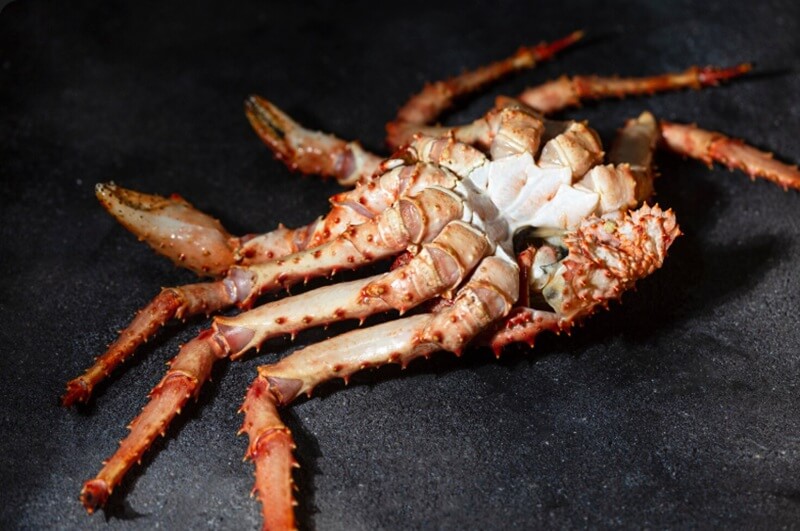
The Bering Sea has a certain type of cold that doesn’t just bite; it creeps into your joints and remains there. This cold is well known to the men who fish for king crab in those seas. They understand what it’s like to be on a heaving deck at three in the morning, when the spray freezes on touch and turns every surface into an ice and salt skating rink.
They also know that some of them won’t make it home, although if few will admit it aloud over drinks at the Dutch Harbor pub. Crab fishermen in Alaska had a fatality rate of about 80 per 100,000 workers, which is about 26 times higher than the national average for all occupations. That number becomes meaningless when it is repeated so frequently. However, the abstraction becomes quite real when you witness a 700 pound steel pot swing loose on a pitching deck for five minutes.
| Category | Details |
|---|---|
| Industry | Commercial King Crab Fishing |
| Primary Location | Bering Sea, Alaska (Aleutian Islands) |
| Peak Season | October – January (Red King Crab) |
| Fatality Rate | ~80 per 100,000 workers (26x national average) |
| Average Deckhand Earnings | Up to $100,000 in a few months |
| Fleet Size | Approximately 80 vessels (Alaska) |
| Key Species | Red King Crab, Opilio (Snow) Crab, Bairdi Crab |
| Governing Bodies | Alaska Dept. of Fish and Game, NOAA, U.S. Coast Guard |
| Notable Cultural Reference | Deadliest Catch (Discovery Channel, 2005–present) |
| Reference | NOAA Fisheries – Alaska |
There isn’t just one thing that makes king crab fishing so deadly. It’s the build up. 30 foot surf, 60 knot gusts, subfreezing temperatures, and darkness always the darkness, as the most lucrative crab seasons occur in late autumn and January, when Alaska hardly sees the sun. Every surface of the boat becomes covered in ice, which can occasionally add 45 tons of weight to the pots alone.
To prevent the ship from capsizing, crew members spend hours swinging sledgehammers and shattering ice spray off the railings and rigging. In an effort to meet the quota before the season ends, the captain is pressuring the crew to work 40 of every 50 hours. Fatigue sets in. Errors ensue. Someone is pulled overboard by a slack rope. A deckhand is pinned to the rail by a swinging pot. These are Tuesdays, not hypotheticals.
With the 2005 introduction of Deadliest Catch on the Discovery Channel, this harsh profession became a sort of spectator sport. Shipwrecks, fires, near drownings, and the tedious tedium of retrieving crab from water so cold it kills you in minutes were all filmed by cameras installed aboard fishing vessels.
The program eventually aired in 150 countries and attracted 3 million people per week in the United States alone. However, possibly inadvertently, the cameras also caught something more sinister than choppy waves.
As dramatic as anything the ocean could throw at them was the personal wreckage that followed these fishermen onshore. While discharging snow crabs in Season 6, Captain Phil Harris had a major stroke on deck. A week later, he passed away at a hospital in Anchorage. At his bedside, the cameras were in motion. Jonathan Hillstrand, his co captain, was unsure if he could view the video. “We’re not characters, we’re real people,” he said to a reporter.
Although Harris’s passing was terrible, it was just the start of a trend that would plague the program. In 2018, Maverick captain Blake Painter was discovered dead in his Oregon home from what seemed to be a heroin overdose.
There were drug related items next to his body. He was 38 years old. Following his father’s passing, Phil’s son Jake Harris descended into criminality and addiction, engaging in hit and runs, possessing heroin, and a car chase with state troopers in an RV that resulted in the discovery of a stolen shotgun and a suspended license.
It’s difficult to determine whether the burden of sudden stardom just exacerbated something that already existed or if grief explains everything. However, the list of Deadliest Catch cast members who have found themselves in courtrooms and prison cells is extensive enough to fill its own episode guide.
Additionally, the ocean has been subtly undermining the entire enterprise. The Alaska red king crab season was completely canceled in 2021 and 2022 not due to regulations, but rather because there were insufficient crabs remaining to harvest. Between 2018 and 2019, snow crab numbers in the southeast Bering Sea fell by almost 90%. Borealization, an ecological transition from Arctic to sub Arctic conditions brought on by climate change, was identified by NOAA experts as the cause of the crash.
The sea ice cycles that snow crabs rely on were disturbed by warmer waters. Their metabolism increased, but the amount of prey they could find was insufficient to meet their increased energy needs. As predators like Pacific fish moved in, the crabs effectively starved in dwindling patches of cold water.
The fishery, which used to bring in an estimated $227 million a year, just vanished. In 2023, Captain Jake Anderson, who had been a regular on Deadliest Catch for eighteen years, had his boat seized. When he arrived at the pier, he saw a repossession notice and a locked chain. A man who survived decades on the Bering Sea losing everything to a spreadsheet seems almost cruel.
Cooler water temperatures in 2022 may provide a temporary relief; during a bottom trawl study, scientists found more juvenile snow crabs, which could result in a partial recovery in roughly five years. However, the long term forecasts are dire. According to climate predictions, just 8% of future years in the southeastern Bering Sea will have the Arctic conditions that snow crabs require. The fishery may not end abruptly. It may just wander northward, away from its usual habitat, pursuing retreating cold water.
All of this has a less obvious aspect as well. Concerns about labor exploitation in the global crabbing industry linger, especially in developing nations that prepare and export crab meat. In certain supply chains, workers are overworked, underpaid, and subjected to hazardous conditions with little legal options.
Even in Alaska, fisherman are forced to take more risks, work longer hours, and take fewer safety precautions due to the financial strain brought on by declining stocks and canceled seasons. Although wounded maritime workers are technically protected by the Jones Act, understanding its legal nuances following a maritime catastrophe can be somewhat challenging.
In the meantime, an unfamiliar phenomenon is taking place thousands of miles away in northern Norway, where king crabs, which were first introduced as a source of protein by Soviet scientists in the 1930s, are now both a tourist attraction and an ecological threat. For “King Crab Safaris,” guests pay to see crabs removed from traps, handle them on land, see them be killed and dismembered, and then consume them at a shared table.
Because the crabs slowly drown over the course of an hour while tourists take pictures with them, researchers who have taken part in these experiences have begun to refer to them as a type of dark animal tourism. Participants seem to find the entire sight less unsettling because the guides portray the crabs as invading pests basically, marine monsters. It’s arguable if this type of tourism differs significantly from other food production methods, but the choreography of it the photos, the laughs, the slow asphyxiation raises difficult considerations.
From a distance, it seems as though king crab fishing is at a peculiar turning point. On television, the glamor of it rough men against a ruthless sea, fortunes gained and lost in a few hard weeks remains popular. However, the human cost has always been greater than the highlight reels indicated, and the environment beneath is changing more quickly than anyone anticipated.
Ratings, quotas, and boat fees are irrelevant to the Bering Sea. The Bering Sea simply continues to exist. Season after season, those who venture out on it continue to make the same age old bet: that the payoff will outweigh the risk. It is for certain people. For some, the price ends up being crucial.
i) https://www.mainelobsternow.com/blogs/resources/why-is-fishing-for-king-crab-dangerous-an-in-depth-look-at-the-risks-and-safety-measures
ii) https://www.grunge.com/158201/tragic-details-that-have-come-out-about-deadliest-catch/
iii) https://www.money.howstuffworks.com/more-dangerous-crab-fishing-or-filming-crab-fishing.htm
iv) https://www.savingseafood.org/safety/the-real-reasons-crab-fishing-is-so-dangerous/