

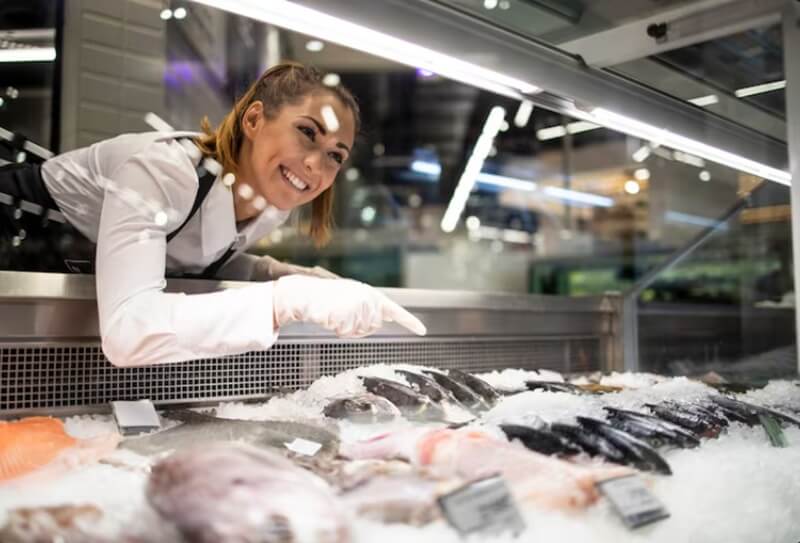
A excellent grocery store’s fish counter has an almost mystical quality. The shimmering fillets in orderly rows, the crushed ice, the small placards that read wild caught or never frozen. It has a healthy vibe. It seems sincere. Additionally, it feels clearly better to the majority of consumers than anything seen in the freezer aisle with frost covered packaging and fluorescent lighting.
However, an increasing amount of data, supported by blind taste tests conducted at Oregon State University, indicates that almost all of the common beliefs regarding fresh versus frozen seafood are, at best, inaccurate and, at worst incomplete.
| Topic | Blind Taste Test: Frozen vs Fresh Seafood |
|---|---|
| Key Study | Oregon State University Blind Taste Tests (2016–present) |
| Research Partners | Ecotrust, Alaska Longline Fishermen’s Association, Seafood Analytics |
| Lead Researcher | Ann Colonna, Oregon State University Food Innovation Center |
| Species Tested | Coho Salmon, Black Cod, Albacore Tuna, Sockeye Salmon, Rockfish, Scallops |
| Key Finding | Flash-frozen seafood rated equal to or statistically better than fresh |
| CQN Score (Cod) | Flash-frozen: 80 vs Fresh: 15 |
| CQN Score (Salmon) | Flash-frozen: 79 vs Fresh: 20 |
| Fresh Seafood Waste Rate | ~33% discarded at supermarket counters |
| Cost Advantage | Frozen seafood approx. 20% cheaper than fresh |
| Reference | Ecotrust — Fresh vs. Frozen Seafood |
The Portland charity Eco trust, in collaboration with Oregon State’s Food Innovation Center, initiated the studies in 2016. The concept was simple: place flash frozen and purportedly fresh fish side by side, allow customers to try both without knowing which was which, and observe the results. One of the later rounds, a scallop tasting in Portland, drew close to a hundred participants. They nibbled on samples that had just been seared.
They evaluated appearance, flavor, texture, and scent. And after it was all finished, not a single taster could tell which scallops were fresh and which had been frozen. Ann Colonna, the lead sensory researcher, put it simply: consumers liked the frozen product just as much as the fresh, or statistically better.
It wasn’t an isolated incident. The same research team conducted panels on rockfish, coho salmon, black cod, albacore, and sockeye over the years. The pattern persisted. Tasters’ descriptions of the flash frozen fillets in the cod study were glowing, whereas their descriptions of the fresh samples were average and poor. The frozen cod was scored as above average or outstanding by more than half of the participants. The new version was not even close.
Furthermore, it was more than just talking about personal preferences. A tool known as a Certified Quality Reader, which passes a low electrical current through fish tissue, was used by scientists to support those impressions. Fresher cells conduct less current because their membranes are still intact. The quality score for the frozen cod was 80. The new cod? Fifteen. The salmon figures, which were 20 for fresh and 79 for frozen, revealed a similar pattern.
The majority of American consumers might be surprised by these findings. Prior to the scallop tasting, Tami Tang, a seafood shopper from Beaverton, Oregon, acknowledged that she always chose fresh from the market. Portland resident Kasey Richards stated that she had long thought frozen seafood was inferior in terms of flavor and texture.
They are not exceptional. When you ask most customers if fresh or frozen is preferable, they respond quickly and almost instinctively. New. Always new. However, the seafood business has been subtly taking advantage of this discrepancy between perception and reality for decades, which has serious repercussions for quality, your pocketbook, and the environment.
The fish that most grocery stores describe as fresh is probably not. This is the aspect that doesn’t receive enough attention. In any case, not the way people envision it. That fillet on ice has probably been harvested days ago, chilled or partially frozen, transported across state borders or oceans, thawed, then put under bright display lights unless you live close to a working pier and are purchasing straight from a boat.
In that chain, quality deteriorates with each hour. The flesh of fish is quite sensitive. As soon as it exits the water, oxidation and enzymes start to break it down. When you see a fillet that has been at sea for four or five days, it is no longer the same fish.
In contrast, flash freezing virtually instantly stops that clock. Within minutes of harvest, modern technology can lock fish at temperatures well below freezing, maintaining their flavor, moisture content, and cell structure in what is essentially a time capsule. A properly frozen fillet is practically out of the water for hours when it is thawed in your kitchen.
The FDA really mandates that raw fish sold at sushi restaurants have been flash frozen in order to prevent bacterial growth and eliminate parasites. The reasoning goes that if it’s good enough for sushi, it should be given more attention in the freezer section.
It’s also difficult to dispute the environmental math. Compared to frozen fish transported by train or truck, fresh seafood frequently has to be flown across the nation or across oceans on short notice, resulting in carbon emissions that are significantly higher. Eco trust’s fisheries program manager, Tyson Rasor, has stated time and time again that the distribution of fresh fish has a much larger carbon footprint than that of frozen fish.
Waste is another issue. If no one buys the fresh seafood at grocery counters, about one third of it is thrown away in two days. Between the ocean and the dinner plate, a quarter of all fish caught a nearly unfathomable amount are wasted. Because frozen fish has a much longer shelf life, it completely avoids that issue.
There is a sense that the industry is aware of all of this, but because customer perception is so ingrained, change has been sluggish. Fresh is preferred by chefs because it sounds better on menus. Retailers want a higher price for it. The stigma associated with the term “frozen” stems from decades of genuinely subpar frozen fish slow frozen, improperly handled items that became mushy and tasteless.
Although there are very few similarities between the ancient method and modern flash freezing, the reputation endures. The Oregon Albacore Commission’s Nancy Fitzpatrick succinctly summed up the problem: after years of advising consumers to purchase tuna fresh during the summer, they are now attempting to persuade those same consumers to enjoy it year round from the freezer. It’s more difficult to change habits than technology.
The fact that every fresh taste test tends to undermine the notion a bit more is promising. The study confirms what fishermen like Jim Stone, who gathers scallops in isolated Alaskan seas, have long known: freezing at sea yields a product that is on par with or superior to anything sent fresh over days or weeks. Because their choices affect consumers, researchers believe that fishmongers and chefs are the most important group to win over.
Additionally, consumers like Tang and Richards appear open to changing their minds after seeing the proof on their own palates. Whether frozen fish will ever completely overcome its image issue is still up in the air. However, the evidence is mounting, taste tests consistently show the same results, and eventually it becomes difficult to continue paying more for something that tastes worse, doesn’t last as long, and is more expensive to produce.
i) https://www.gethookedseafood.com/blogs/news/fresh-vs-frozen
ii) https://www.alaskagoldbrand.com/blogs/news/flash-frozen-seafood
iii) https://www.delish.com/kitchen-tools/kitchen-secrets/a70106997/frozen-vs-fresh-fish-taste-test/