

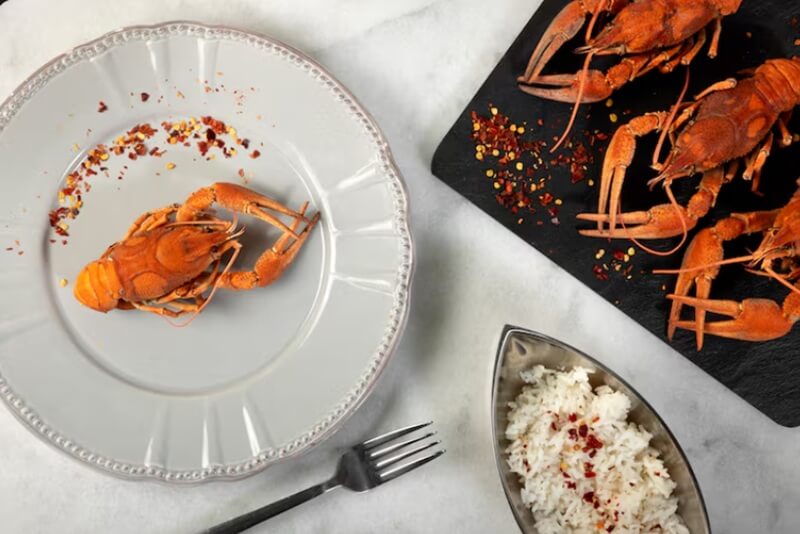
A metal dish of sticky rice is being lowered into boiling oil somewhere on Pham Ngu Lao Street in District 1 of Ho Chi Minh City. The next step in the procedure, which takes roughly forty minutes from steaming to plating, is already scheduled as the cook watches the edges crisp and turn golden. The delectable meat of a full Ca Mau crab,
weighing at least 600 grams, has already been plucked clean and combined with pork floss, shiitake mushrooms, and lap xuong sausage. The final product, a sculptural dome with the crab’s shell and claws on top, will set you back 990,000 Vietnamese dong. In a city where a bowl of pho costs about two dollars, that is about forty dollars.
| Field | Details |
|---|---|
| Subject | Economics of premium crab dishes in restaurants |
| Key Price Point | $40 per serving (varies $25–$55 globally) |
| Raw Crab Cost (Ca Mau, Vietnam) | $22–$25 per kilogram |
| U.S. Snow Crab (Retail) | ~$18–$30 per pound (2025–2026) |
| Restaurant Markup | Typically 200–400% on raw ingredient cost |
| Notable Reference | Sonny Side (Best Ever Food Review Show), 11.2M+ YouTube subscribers |
| Pentagon Crab Spending (Sept. 2025) | $2 million on Alaskan king crab in one month |
Sonny Side, a food YouTuber with over 11 million followers to his Best Ever Food Review Show, recently visited this eatery and described the dish as indescribable. He pauses in the middle of the mouthful at one point in the video, obviously adjusting his expectations. He observed that the typical sweetness of the crab claws was replaced with an umami depth.
Between his teeth, the sticky rice crackled. However, the money is something that the camera virtually never captures. In reality, where does that forty dollars go? Who makes money, who barely makes ends meet, and who initially determines the price?
The raw crab alone costs between $22 and $25 per kilogram, according to Luong Thanh Hoang, the restaurant’s owner, who spoke with Vietnamese media. That is the wholesale price for high quality crab that is sourced especially for its firm texture and inherent sweetness from Nam Can, Ca Mau province.
$40 doesn’t seem like a markup when you factor in the price of Nep Cai Hoa Vang glutinous rice, a premium variety that most home cooks wouldn’t bother with, the sausage, the mushrooms, and the work of forty minutes of painstaking assembly. It appears to be nearly fair.
Nearly. Because fairness in the restaurant industry is always a matter of viewpoint. The mangrove seas of Ca Mau do not pay the crab fishermen $22 per kilogram. Long before the crabs are delivered to a District 1 kitchen, middlemen, transportation expenses, and cold chain logistics take their cut. The individual who works the hardest and riskiest jobs in this chain,
such as moving traps through brackish water or sorting live crabs by weight at daybreak, can receive the least amount. Restaurant owners are rarely willing to enumerate their supply chain for journalists, and there is no simple way to confirm the precise breakdown. However, anyone who has studied fish economics anywhere in the world will recognize the trend.
The picture becomes more bizarre on the other side of the Pacific. With a new CEO, a new TikTok strategy, and a new seafood boil that starts at $39.99, Red Lobster, the American chain that declared Chapter 11 bankruptcy in May 2024, recently came out of reorganization. Claw crackers, branded bibs, and lemon scented wet wipes are delivered to your table along with the boil in a plastic bag filled with steam.
After sampling the $54.99 version at the Times Square restaurant, a culinary writer rated the smoked sausage as the dish’s greatest ingredient, surpassing the lobster, crab legs, and everything else that was meant to be the main attraction. He noted that the garlic butter appeared to be intended to cover up rather than to enhance a salty tsunami that crashed over subpar seafood. The most stunning part of that $55 lunch might be the sausage slice.
This tension doesn’t end smoothly. Restaurants require profit margins. Diners are looking for show. Additionally, crab is more popular in theaters than nearly any other protein because of its breaking, dipping, and shell pile, which demonstrate that you have consumed a primordial food.
You’re paying in part for the sensation of using your hands to disassemble your food, whether it’s a sizzling bag in Midtown Manhattan or a sculpted sticky rice dome in Saigon. The price includes that chaotic, sometimes absurd sense of deserved pleasure.
However, there is another type of crab spending that makes forty dollars seem like a small amount. According to a research by government watchdog Open the Books, the U.S. Department of Defense spent $6.9 million on lobster tail and $2 million on Alaskan king crab in September 2025. Additionally, the Pentagon under Defense Secretary Pete Hegseth spent $15.1 million on ribeye, $124,000 on ice cream machines, and almost $100,000 on a Steinway grand piano.
The expenditure occurred around the close of the fiscal year, a time when federal agencies were known for their use it or lose it budgetary practices. Congresswoman Summer Lee of Pennsylvania noted that her county’s whole homelessness outreach program could be funded twice more by the military’s yearly crab expense.
It’s difficult to ignore the ridiculousness of discussing whether a Vietnamese chef’s $40 masterpiece is excessive while the Pentagon secretly spends millions on crustaceans that no one takes pictures of for TikTok.
Crab has an odd cultural significance even at the grocery store level. Publix’s under $25 crab boil, in which patrons select their shellfish at the counter, select their spices, and have it steam cooked on the spot, went viral recently. Without a doubt, it’s a good value, especially when you consider that a sit down restaurant might charge you $70 for the same amount of food. However, the comment sections provide insightful information.
Flavor is hardly the only topic people discuss. They discuss access, whether this type of cuisine should be accessible to everyone or if it should only be provided on rare occasions. Jason Greenslate, a surfer from California, gained notoriety in the food stamp controversy years ago after Fox News captured him using his SNAP funds to purchase lobster.
Lobster wasn’t the main cause of the outcry. It was about who should have a good meal and the unsettling fact that lobster and crab have come to represent class, ambition, and bitterness in society Smaller amounts of the crab sticky rice, adjusted for various budgets,
are available at the restaurant on Pham Ngu Lao Street in Ho Chi Minh City for around $27. It’s a sensible gesture that recognizes that various eaters have varied interpretations of $40. Some travelers find it to be an enticing novelty.
It may be a once a year indulgence for a local family, captured on camera and shared with the same respect that Americans have for Thanksgiving turkey. Pickled shallots and a unique dipping sauce which the proprietor won’t go into detail about are given with the dish, which takes forty minutes to cook and calls for the entire meat of a single crab.
Who makes money off of your $40 crab dish? Depending on where you are seated at the table, everyone or nobody. The fisherman makes enough money to continue fishing. The restaurant makes enough money to maintain its operations. The intermediary makes enough money to remain undetectable.
And the diner receives a memory something golden and crispy that tasted, at least for a few nibbles, like it was worth every penny. While the crab is still warm, most of us would rather not consider if that math holds up under scrutiny.
i) https://www.npr.org/sections/itsallpolitics/2013/09/19/223796325/lobster-boy-looms-large-in-food-stamp-debate
ii) https://www.businessinsider.com/restaurants-on-royal-caribbean-wonder-of-the-seas-cruise